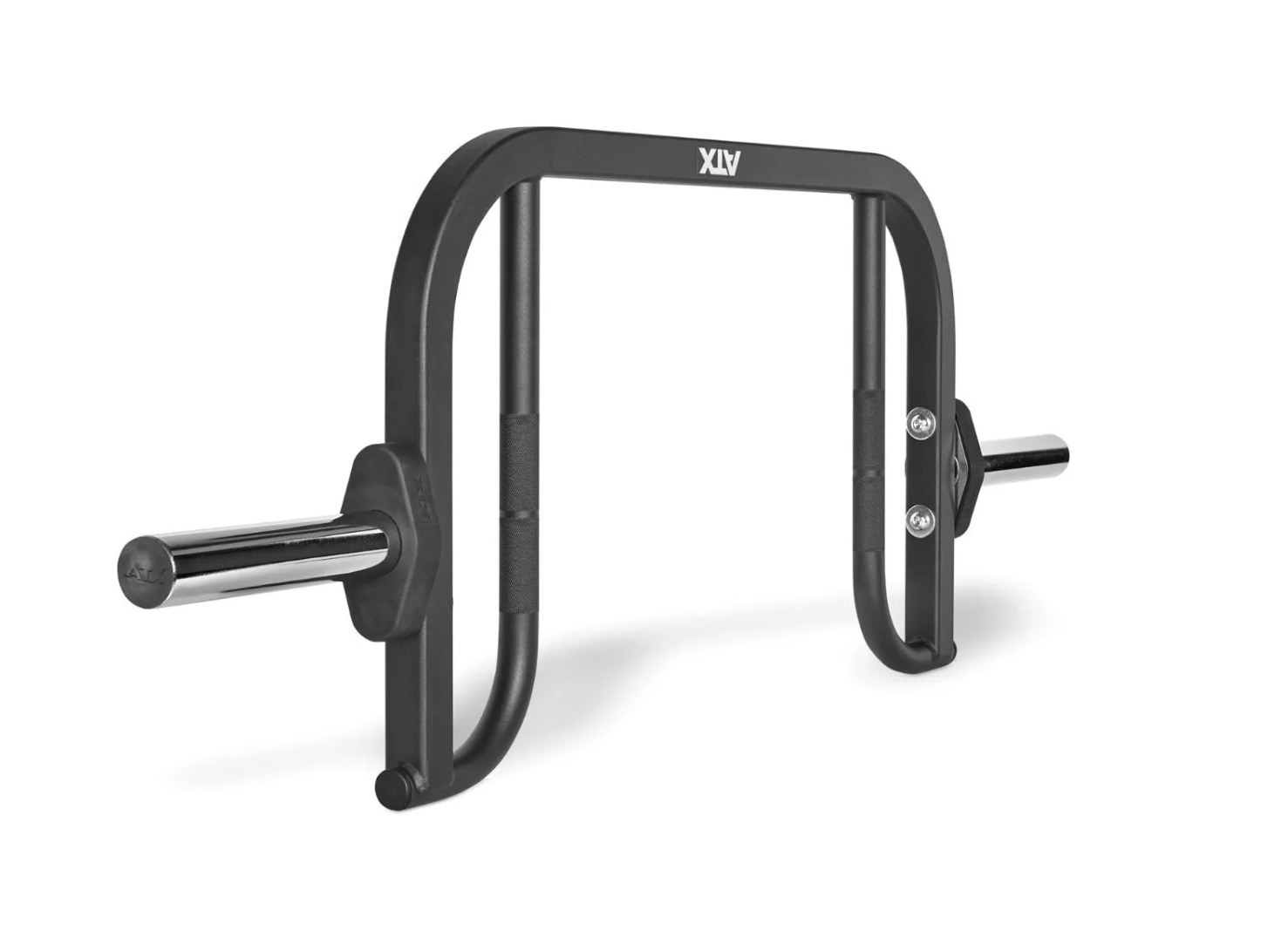
ATX Open Trap Bar Review: Flawed, But Surprisingly Useful
It’s one of the smallest open trap bars on the market, and in my 4×3m home gym - space is valuable. But was the space-saving worth it?
The ATX HEX-50 is not the best open trap bar I’ve used, not even the best open trap bar I own.
But after around six weeks of training with it, it became the one I was actually reaching for most often, due to its convenience.
My home gym is only 4 × 3 metres, so equipment has to do more than perform well once it is set up. I need to be able to store it, move it around the room and get it into position without turning every workout into a furniture-removal exercise.
At 1.5 metres long and, as I stated in my original video review, around 12 kg, the ATX HEX-50 is significantly easier for me to live with than a conventional full-size open trap bar.
Unfortunately, ATX has also made some strange design decisions, including one particularly frustrating problem with the balance of the bar.
So this is not a trap bar I would recommend to everyone.
For the right small home gym, though, it makes a surprising amount of sense.
ATX HEX-50: My Verdict
Best for: Small home gyms where storage, weight and manoeuvrability matter more than maximum loading capacity.
Not ideal for: Lifters with plenty of space, very heavy deadlifters, or anyone wanting a premium full-size open trap bar.
Price paid: £149
Length: 1.5 m
Weight: approximately 12 kg
Handle diameter: 32 mm
Handle positions: One
Maximum stated load: 250 kg
Loadable sleeve length: approximately 25 cm
Built-in deadlift jack: No
Rackable: No
What I like
Extremely compact for an open trap bar
Light and easy to move around a small gym
Easy to store vertically
Excellent for chest-supported rows, deadlifts, Romanian deadlifts, shrugs
Narrower handle position suits me better than some wider trap bars
Good knurling for the price
Chrome sleeves and rubber sleeve stops are nice touches
Can be used creatively with a functional trainer (see video for examples!)
What I don't like
The bar is badly balanced when you grip the marked centre of the handles at lower weights
No built-in deadlift jack
It isn't rackable
Only one handle height
Short sleeves limit how much weight you can practically load with bumper plates
The powder coat appears to scratch relatively easily
Why I Bought a Compact Trap Bar
The exercise that originally made me want the HEX-50 wasn't actually the deadlift. It was the chest-supported row.
I wanted something I could use around an adjustable bench without needing another dedicated machine in the gym. The open frame of a trap bar is ideal for this because the bench can sit inside the bar rather than getting in the way of it.
The ATX works extremely well for this.
I can use a normal adjustable bench, or make a simple chest-support setup from equipment I already own, and the compact dimensions make positioning the bar much easier than with my larger Bulldog Gear open trap bar.
My Bulldog Gear bar is a better piece of equipment once it is in position. The problem is that it’s large, heavy and difficult to store. The ATX is much easier to pick up, move and put away.
That difference has resulted in me using the ATX once or twice a week since buying it.
What Exercises Can You Do With the ATX HEX-50?
Chest-supported rows have probably been my favourite use for the bar.
The open frame works naturally around a bench, while the relatively narrow handle position feels comfortable to me. I've used wider open trap bars where it feels as though my hands are being pushed unnecessarily far apart.
I've also used the HEX-50 successfully for:
Chest-supported rows
Pendlay rows
Shrugs
Deadlifts
Romanian deadlifts
Shoulder presses
Deadlifts and Romanian deadlifts feel exactly as useful as you would expect from an open trap bar.
Shrugs also feel excellent.
But there is a significant design flaw that affects all of these movements.
The Biggest Problem: The Bar Isn't Properly Balanced
This is easily my biggest criticism of the HEX-50. There are markings in the middle of the knurled handles which naturally suggest where the centre of your hands should sit. If you grip the bar there and relax your hands, however, the front of the bar tips down.
It isn't balanced - at least at lower weights.
To get the bar sitting level, I have to move my hands further towards the front of the handles.
You notice it during shrugs and pressing, even just picking the empty bar up.
I can work around it, and I have been doing exactly that, but I don't think the low price completely excuses it. This is one of the fundamental things the bar needs to get right.
A simple improvement would have been to extend the knurling across more of the handle so that the actual balance point provided a proper gripping surface.
As the weight gets heavier, the centre of mass evens out - but not until I had 130kg+ loaded.
The Missing Deadlift Jack
Unlike many modern open trap bars, the ATX doesn't have an integrated deadlift jack.
That is inconvenient when loading and unloading plates. But I also think it may partly explain the balance problem.
On many larger open trap bars, the structure that allows the bar to stand upright for loading also adds mass to the open side of the frame.
The HEX-50 doesn't have that counterweight.
Whether that is definitively the cause or not, the absence of a jack creates two compromises: loading the bar is less convenient, and the frame feels noticeably front-heavy in use.
How Much Weight Can You Put on It?
ATX states a maximum load of 250 kg. The more relevant limit for many home-gym owners is probably the sleeve length.
There is roughly 25 cm of loadable sleeve on either side. With the bumper plates I use, I would expect to reach roughly 150 kg before space becomes the limiting factor.
Thinner iron or competition plates would allow considerably more weight to fit on the sleeves. For somebody pulling very heavy deadlifts, though, I wouldn't choose this bar in the first place.
A larger open trap bar from Bulldog Gear, REP or another manufacturer gives you substantially more loading space and is better suited to that job.
Build Quality
The sleeves are chrome and include rubber stops where the plates meet the frame. The matte black powder-coated frame looks and feels good when new.
I have, however, already noticed some scratches developing in the finish. I've seen something similar on another ATX speciality bar using what appears to be a similar coating.
For gym equipment, that doesn't particularly bother me, but it is worth knowing.
Why I Still Use It
At 1.5 metres long, I can put the HEX-50 into my bar storage and effectively make it disappear when I'm not using it. Most full-size barbells are around two metres or more, which makes vertical storage more difficult in my room.
My larger Bulldog Gear trap bar can't easily go on the wall or into my normal bar storage, so it ends up occupying floor space.
And this isn't only my gym.
It's a shared room.
Having a 30 kg, two-metre-plus speciality bar permanently sitting on the floor isn't particularly considerate when somebody else also needs to use the space.
The ATX may give me only 60–70% of what I would want from the perfect open trap bar.
But I can store it, move it. and crucially, I actually use it.
Should You Buy the ATX HEX-50?
If you have plenty of space and enough budget for a full-size premium open trap bar, I wouldn't buy the HEX-50.
A larger bar gives you better loading capacity, easier heavy training and, depending on the model, features such as multiple handle heights and an integrated deadlift jack.
The ATX starts to make more sense when space becomes the constraint.
If your home gym is around 4 × 3 metres or smaller, the compact dimensions can be genuinely useful.
ATX HEX-50 vs Other Compact Trap Bars
When I bought the ATX, I had originally looked at the compact Bells of Steel open trap bar. but it was out of stock at the time.
By the time I filmed my review it was available again for £99 and included a built-in deadlift jack, making it an alternative I think compact-gym owners should consider.
Mirafit also offered a bar of a similar overall length, although it was heavier.
At the other end of the market are larger open trap bars such as my Bulldog Gear bar and models from brands including REP.
Those are the products I would choose where storage and manoeuvrability aren't significant constraints.
The HEX-50 isn't really trying to beat those bars at their own game.
Its advantage is simply that it takes up much less room.
Final Verdict
The ATX HEX-50 is overall, a solid choice. The balance problem shouldn't exist, though you can work around it. The lack of a built-in deadlift jack is frustrating.
The short sleeves reduce its usefulness for very heavy training, and the compact dimensions mean you can't rack it like a conventional full-size bar.
But none of that changes the reason it has stayed in my gym. It's easy to store, easy to move and versatile enough that I regularly find reasons to use it.
For someone with plenty of space, I think there are better open trap bars to buy. For someone trying to squeeze as much useful training equipment as possible into a genuinely small home gym, the HEX-50 is much easier to justify.
Sometimes the best piece of equipment isn't the one with the best specification sheet.
It's the one that actually gets used.
ATX HEX-50 FAQ
Is the ATX HEX-50 good for a small home gym?
That's where I think the bar makes the most sense. At 1.5 metres long, it is much easier to move and store than most full-size open trap bars. In my 4 × 3 metre gym, that is the main reason I continue to use it.
Can you deadlift with the ATX HEX-50?
Yes. I've used it for both conventional trap-bar deadlifts and Romanian deadlifts. The main limitations are the relatively short loadable sleeves and the balance of the bar.
Does the ATX HEX-50 have a deadlift jack?
No. Unlike many open trap bars, the HEX-50 doesn't include an integrated deadlift jack.
Is the ATX HEX-50 rackable?
Not on a normal full-width power rack in the way a standard barbell or larger rackable trap bar is. Its compact overall length is what makes it convenient to store, but that creates a limitation for exercises such as rack-based shoulder pressing.
How much weight can the ATX HEX-50 hold?
ATX states a maximum load of 250 kg. In practice, plate thickness and the approximately 25 cm loadable sleeve length may become the limiting factor first. With my bumper plates, I estimated that roughly 120 kg would fit.
Would I recommend it?
If you have plenty of space, I would choose a larger open trap bar.
If storage space is a major constraint, the ATX HEX-50 becomes much more interesting. Despite its flaws, it has remained in regular use in my own 4 × 3 metre gym because it is compact enough to store out of the way when I finish training.
Available here, from The Gym Revolution